

AI search engines answer questions. They don't rank pages. They don't scroll through listings. They extract the most specific, structured answer they can find and serve it directly to the user.
ChatGPT, Perplexity, and Google AI Overviews are now handling queries like "Is there parking near this hotel?", "Are there restaurants walking distance from this venue?", and "How do I get there by public transport?"
If your listing doesn't have a structured, specific answer to those questions, it gets skipped entirely.
And here's the part most businesses miss: answering the obvious questions is not enough anymore.
The Problem With Generic FAQs
Most hotels, restaurants, and real estate listings have an FAQ section. On paper, that sounds like a good thing. In practice, almost all of them look like this:
Q: Does the hotel have parking? A: Yes, parking is available.
Q: Are there restaurants nearby? A: Yes, there are several restaurants in the area.
Q: Is the property close to public transport? A: Yes, public transport is easily accessible.
These answers are technically correct and functionally useless. They don't tell an AI system anything it can use to make a recommendation. They don't tell a human anything that builds confidence.
When someone asks ChatGPT "Is there parking near Hotel X in Florence?", the AI is looking for specifics: how many spaces, what type, what size vehicles fit, what it costs, whether you can leave luggage in the car overnight. If all it finds is "yes, parking is available," it either skips you or hallucinates the details.
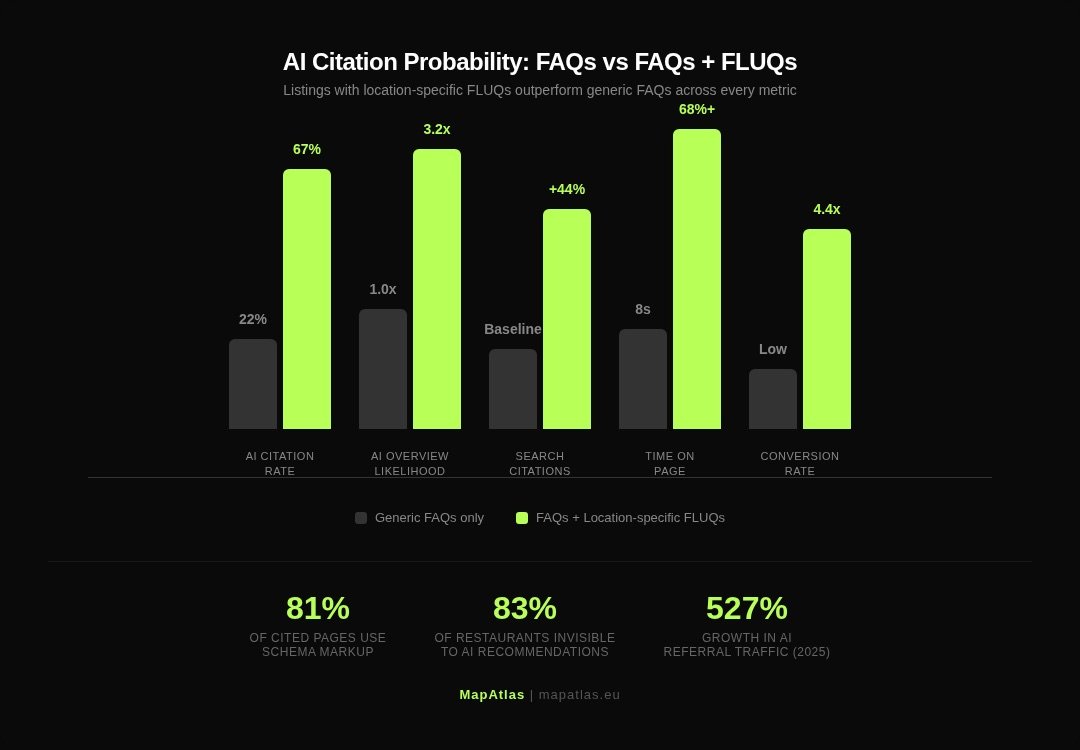
81% of web pages that get cited by AI systems include schema markup. Pages with FAQPage schema are 3.2x more likely to appear in Google AI Overviews. But schema alone is not enough if the content inside it is generic.
FAQs Get You Found. FLUQs Get You Chosen.
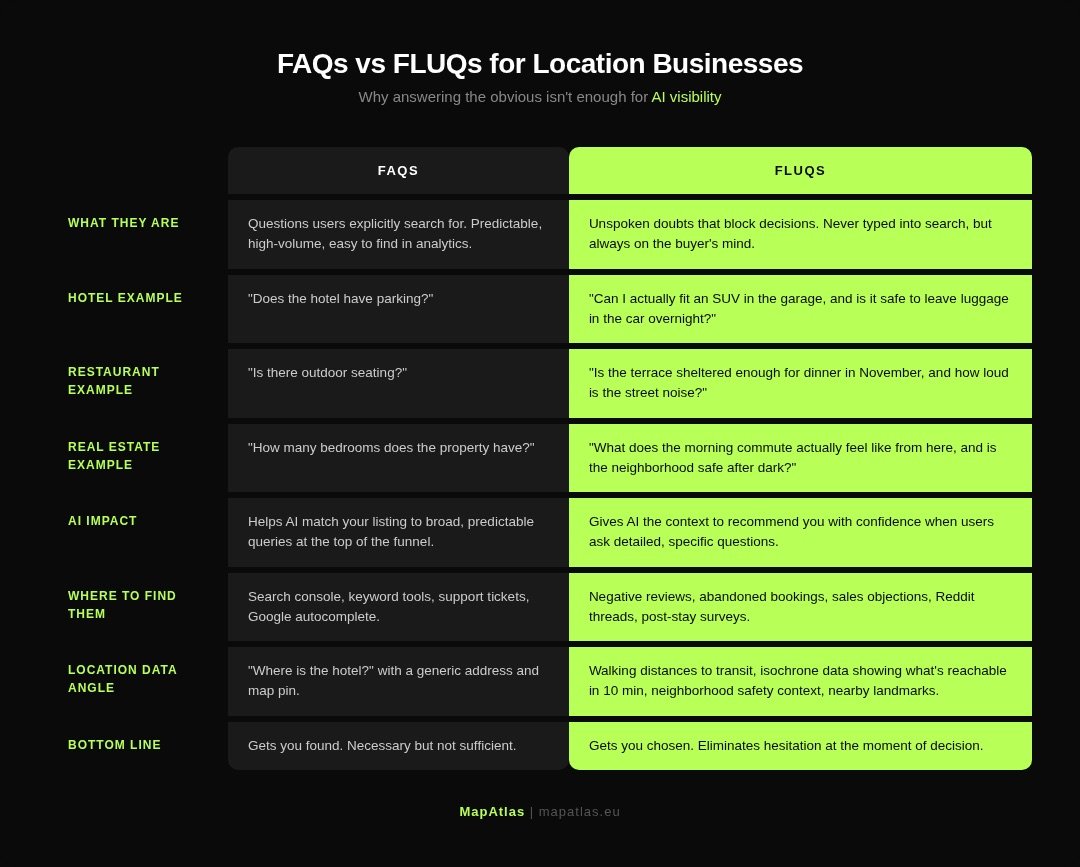
There is a concept gaining traction in AI search strategy called FLUQs: Friction-Inducing Latent Unasked Questions. The term was coined by Garrett French at Citation Labs, and it describes something every hotel, restaurant, and property manager already knows intuitively but rarely acts on.
FAQs are the questions people type into search. FLUQs are the questions people think about but never ask, the doubts that quietly kill bookings, reservations, and property inquiries.
A FAQ is: "Does the hotel have parking?" A FLUQ is: "Can I fit an SUV in the garage, and is it safe to leave luggage in the car overnight?"
A FAQ is: "Is there outdoor seating?" A FLUQ is: "Is the terrace sheltered enough for dinner in November, and how loud is the street noise?"
A FAQ is: "How many bedrooms does the property have?" A FLUQ is: "What does the morning commute actually feel like from here, and is the neighborhood safe after dark?"
FAQs help AI match your listing to broad, predictable queries at the top of the funnel. FLUQs give AI the context to recommend you with confidence when users ask detailed, specific, decision-stage questions.
The difference matters because AI referral traffic grew 527% between January and May 2025. AI-driven visitors convert at 4.4x the rate of organic visitors and spend 68% more time on page. These are not casual browsers. These are people ready to decide, and they are asking questions your generic FAQ section cannot answer.
What Location-Specific Actually Means
The biggest gap in most FAQ sections is location context. Not the address. Not a Google Maps pin. The actual experience of being at that location.
Here is what a generic listing tells AI:
- Address: Rua da Rosa 45, Lisbon
- Neighborhood: Bairro Alto
Here is what a location-specific listing tells AI:
- 4-minute walk to Bairro Alto metro station
- 12 restaurants within 300 meters, including 3 with outdoor seating
- Walkability score: 94/100
- Average noise level at night: moderate (pedestrian zone, no vehicle traffic after 10pm)
- Nearest grocery store: 2 minutes on foot
- Morning commute to Parque das Nacoes: 22 minutes by metro
The second version answers questions the user hasn't even asked yet. And that is exactly what AI systems need to make confident, specific recommendations.
When Perplexity AI processes 780 million queries per month, it evaluates content based on relevance, authority, freshness, and clarity. It prioritizes direct, factual answers over promotional material. Structured location context is the kind of content it cites. Marketing copy is the kind it skips.
How to Build Location-Specific FAQs and FLUQs
Step 1: Audit your current FAQ section
Run your listing through the MapAtlas AEO Checker. It tests against 29 structured signals including FAQ presence, location schema, nearby landmarks, and transit data. Most businesses score lower than they expect.
Step 2: Rewrite every generic answer with specifics
Before:
Q: Is there parking? A: Yes, parking is available.
After:
Q: Is there parking near the venue? A: The venue has a private underground garage with 40 spaces. Height clearance is 2.1 meters, which fits most SUVs. Hourly rate is 3 EUR, daily maximum is 18 EUR. There is also street parking on Via Roma (free after 8pm, 2-hour limit during the day). The nearest public garage is Parking Centrale, 200 meters east, open 24 hours.
Step 3: Find your FLUQs
FLUQs don't show up in keyword research. They show up in:
- Negative reviews ("I wish I had known that...")
- Abandoned bookings (what made them leave?)
- Questions your sales team hears after trust is established
- Reddit threads about your location or neighborhood
- Post-stay surveys and feedback forms
Look for patterns. The questions that keep coming up after someone has already shown interest are almost always FLUQs.
Step 4: Add structured location data
Every FAQ answer that references a location should include structured data. Coordinates, walking distances, isochrone data (what's reachable in 5, 10, 15 minutes), transit options, and neighborhood context.
This is the layer that makes your FAQ content machine-readable. Without it, AI has to guess. With it, AI can calculate, compare, and recommend.
The geo field in your JSON-LD schema (latitude and longitude coordinates) is the single most impactful field for AI citation that most implementations skip. An address tells AI your mailing location. Coordinates tell AI your exact position on the planet.
Step 5: Implement FAQPage schema
Wrap your FAQ content in proper JSON-LD FAQPage markup. This makes extraction effortless for AI systems and increases your citation probability significantly. Pages with FAQ schema show a 22% median citation lift in AI-generated search results.
Make sure every question contains the full text and every answer contains the full text. Match schema values to visible page content. Validate with Google's Rich Results Test.
The Real Estate Angle
Real estate is where this gap is most visible. Most property listings answer: "What does this home look like?" Very few answer: "What does life here actually feel like?"
When someone asks an AI "show me apartments near the park in Amsterdam," the AI resolves structured location data. Coordinates. Proximity. Density. Transit accessibility. Neighborhood demographics.
If your listing has none of that, the AI has nothing to work with. It doesn't matter how beautiful the photos are or how well-written the description is. Without structured location context, your listing is invisible to the fastest-growing discovery channel in real estate.
We ran an A/B test on real estate listings. Same properties. Same prices. Same photos. The only difference: one version added structured location context. Not marketing text. Actual data about what it's like to live there. Walkability, transit time, safety, nearby amenities, who actually lives in the neighborhood.
The listings with location context held attention longer, generated more inquiries, and converted better, especially with remote buyers. Not small improvements. Clear shifts in behavior.
The Bottom Line
AI referral traffic is growing faster than any other channel. Gartner forecasts that 25% of organic search traffic will move to AI by 2026. Google AI Overviews already appear in nearly 20% of searches.
Your FAQ section is no longer just a support page. It is one of the primary interfaces between your business and AI search engines.
If that interface contains generic, thin, locationless content, you are invisible to the systems that are increasingly deciding which businesses get recommended and which ones don't.
The fix is not complicated:
- Replace every generic FAQ answer with location-specific details
- Identify and answer your FLUQs (the unasked questions that block decisions)
- Add structured location data (coordinates, distances, isochrones, transit)
- Implement FAQPage schema markup
- Test your listing with the free MapAtlas AEO Checker
FAQs get you found. FLUQs get you chosen. Together, with real location data underneath, they give AI everything it needs to recommend you with confidence.
Frequently Asked Questions
What is the difference between a FAQ and a FLUQ?
A FAQ (Frequently Asked Question) is a question people commonly type into search engines. A FLUQ (Friction-Inducing Latent Unasked Question) is a question people think about but never ask - the hidden doubt that quietly blocks a booking or inquiry. FAQs help AI find you. FLUQs help AI recommend you.
Why do AI search engines skip generic FAQ answers?
AI systems like ChatGPT, Perplexity, and Google AI Overviews are looking for specific, factual, structured answers they can cite directly. A generic answer like 'Yes, parking is available' gives AI nothing useful to work with. It either skips your listing or hallucinates details. Specific answers with numbers, distances, costs, and context are what get cited.
What is FAQPage schema and why does it matter for AI search?
FAQPage schema is JSON-LD structured data markup that wraps your FAQ content in a machine-readable format. Pages with FAQPage schema are 3.2x more likely to appear in Google AI Overviews and show a 22% median citation lift in AI-generated results. Schema makes extraction effortless for AI systems.
What location data should I add to my FAQ answers?
Include walking distances to transit stops, nearby restaurants and amenities with counts and distances, parking specifics (spaces, height clearance, cost, hours), noise levels, walkability scores, commute times, and neighborhood safety context. Geo coordinates in JSON-LD schema are particularly impactful as they tell AI your exact position rather than just a mailing address.
How do I find the FLUQs for my business?
Look at negative reviews for 'I wish I had known...' patterns, check abandoned bookings, listen to questions your sales team hears after initial interest, read Reddit threads about your location or neighborhood, and analyse post-stay surveys. The questions that keep coming up after someone has already shown interest are almost always FLUQs.
How can I check if my listing is optimised for AI search?
Use the free MapAtlas AEO Checker at mapatlas.eu/ai-seo-checker. It tests against 29 structured signals including FAQ presence, location schema, nearby landmarks, and transit data. Most businesses score lower than they expect.
